
 Skip to content


If you were hurt on someone else’s property in San Antonio, you are likely dealing with painful injuries, unexpected medical expenses, and serious questions about what happens next. You may be wondering whether the property owner is responsible for what happened to you, and whether you have the right to seek compensation for the harm you have suffered. These are valid concerns, and you should not have to face them alone while trying to recover from an injury that someone else’s negligence caused.
Property owners and business operators in Bexar County have a legal duty to keep their premises reasonably safe for the people who enter them. When a property owner fails to fix a known hazard, ignores a dangerous condition, or does not bother to warn visitors about a risk that could cause serious harm, that owner can be held liable for the injuries that result. The National Floor Safety Institute reports that fall accidents alone account for more than eight million emergency room visits across the country each year, and slip and fall incidents make up more than one million of those visits.[1] The Centers for Disease Control and Prevention confirms that falls are the leading cause of injury-related emergency department visits for older adults, with approximately three million visits recorded among people age 65 and older each year.[2]
At Jim Adler & Associates, our San Antonio premises liability lawyer team has spent decades fighting for injured Texans against negligent property owners and the insurance companies that protect them. We understand what you and your family are going through, and we are ready to help you pursue the full compensation you deserve.
With offices serving San Antonio and communities throughout Texas, our team can move quickly to investigate the property conditions and start building your premises liability case. Your first step is a FREE premises liability case review.
Call 1-800-505-1414 now or click here to get started online.
Premises liability is the area of personal injury law that holds property owners and occupants responsible when someone is hurt because of a dangerous condition on their property. The core principle is straightforward, and it applies whether the property in question is a grocery store, a restaurant, an apartment complex, an office building, or a private home. If a property owner knew about a hazard, or reasonably should have known about it, and failed to address the danger or warn visitors, that owner may be held liable for any injuries that result from the unsafe condition.
The level of care a property owner owes depends on the visitor’s legal classification under Texas common law. An invitee is someone who enters the property for the mutual benefit of both parties, such as a customer shopping at a store or a restaurant patron, and invitees receive the highest level of protection. Property owners owe invitees a duty to inspect the premises for hidden dangers and to make the property reasonably safe. A licensee is someone who enters the property with the owner’s permission for their own purposes, such as a social guest visiting a friend’s home, and property owners must warn licensees about known hidden hazards. A trespasser is someone who enters without permission, and while property owners generally owe trespassers only the duty to not cause intentional harm, an important exception exists for children. Under the attractive nuisance doctrine, property owners can be held liable for injuries to children caused by dangerous features on the property, such as an unfenced swimming pool, even if the child was technically trespassing.[3]
Negligence in a premises liability case means that the property owner failed to act as a reasonably prudent person would under similar circumstances. A negligent property owner might ignore a recurring wet floor, fail to repair broken stairs, skip required building code inspections, or refuse to install adequate lighting in a parking lot. When that failure to act causes an accident that injures someone, the property owner can be held financially responsible for the resulting damages. It is also important to understand that the Texas Civil Practice and Remedies Code, Chapter 33, Section 33.001 applies a comparative negligence rule, also called proportionate responsibility, to these cases.[4] Under this rule, your compensation is reduced by your percentage of fault, and you cannot recover anything if you are found to be more than 50 percent responsible for the incident. Insurance companies routinely try to shift blame onto injured people to reduce what they owe, which is one reason why having an experienced San Antonio premises liability lawyer on your side matters so much from the very beginning.
Not every injury on someone else’s property leads to a valid premises liability claim, but many do. The key question is whether the property owner knew about the dangerous condition, or should have known about it, and failed to take reasonable steps to fix the problem or warn visitors. Property owners who ignore hazards, cut corners on maintenance, or look the other way when safety standards are not being met can be held financially responsible when someone gets hurt as a result. Understanding the situations that create liability can help you recognize whether the property owner who caused your injury should be held accountable.
A dangerous condition is any physical feature of the property that poses an unreasonable risk of harm to visitors. Common examples in San Antonio include wet floors in grocery stores and restaurants, broken stairs in apartment buildings, cracked or uneven sidewalks outside businesses, potholes in parking lots, loose handrails on stairways, and debris left in walkways where people are expected to walk. The hazardous condition does not need to be dramatic or obvious to create liability, and even a small puddle of water or a slightly raised section of flooring can cause a devastating fall that results in a traumatic brain injury, a fractured hip, or a spinal cord injury.
What matters legally is whether the property owner or property manager knew the condition existed, or whether the hazard had been present long enough that a reasonably careful owner should have discovered it through routine inspection. A grocery store that ignores a spill in its produce aisle for an hour, or a landlord who refuses to fix a broken step that tenants have complained about for months, may face strong liability when someone is injured by that unsafe condition.
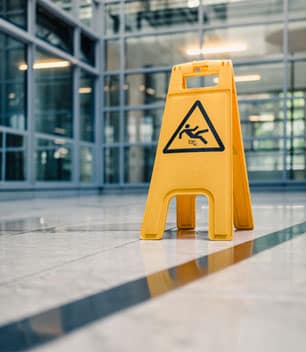
Property owners in Texas have a duty to either fix dangerous conditions within a reasonable time or provide adequate warning to visitors until repairs can be made. A failure to warn occurs when the property owner knows about a hazard and does nothing to alert visitors to the danger. Placing a simple wet floor sign, roping off a damaged area, or posting a notice about ongoing repairs can make the difference between a responsible property owner and a negligent one. When no warning is given and someone is hurt, the owner’s failure to warn becomes a central piece of evidence in a premises liability case.
The duty to repair goes further than simply posting a sign. Property owners cannot use a warning sign as a permanent substitute for actually fixing the problem. A landlord who places a handwritten note near broken stairs for six months instead of repairing them is not fulfilling the duty of care that the law requires. Our premises liability attorney team at Jim Adler & Associates investigates whether the property owner took reasonable steps to address the hazard, how long the dangerous condition existed before your accident, and whether the owner’s failure to act was the direct cause of your injuries.
Property owners who invite the public onto their premises also have a responsibility to provide reasonable security measures that protect visitors from foreseeable criminal activity. Negligent security claims arise when an assault, robbery, or other violent crime occurs on someone else’s property and the property owner failed to take basic precautions that could have prevented the attack. Hotels, apartment complexes, parking garages, nightclubs, shopping centers, and convenience stores in San Antonio all have an obligation to assess the risk of criminal activity on their property and respond with appropriate safety measures.
Inadequate lighting in parking lots, broken locks on apartment doors, missing security cameras, and the absence of security personnel in high-crime areas are all examples of conditions that may support a negligent security claim. When a property owner knows that criminal incidents have occurred on or near the premises and does nothing to improve safety, that owner may be held liable for injuries that result from a subsequent assault or attack. These cases can be especially complex because they involve proving that the crime was foreseeable and that better security would have prevented it, which is why having a San Antonio premises liability lawyer with experience handling negligent security claims is so important.
Every premises liability case comes down to whether the property owner breached the duty of care owed to the injured person. A breach of duty occurs when the property owner fails to act as a reasonably prudent person would under the same circumstances, and that failure creates a dangerous situation that leads to someone getting hurt. The standard is not perfection, and property owners are not expected to eliminate every conceivable risk. The standard is reasonableness, which means taking the steps that a careful, responsible owner would take to identify hazards, address them promptly, and protect visitors from foreseeable harm.
Proving a breach of duty often requires showing a pattern of neglect rather than a single oversight. Maintenance logs that reveal missed inspections, code violations documented by city inspectors, complaints from other tenants or visitors about the same hazard, and evidence that the owner chose to save money rather than make necessary repairs can all demonstrate that the property owner failed to meet the standard of care. Jim Adler, The Texas Hammer®, and our legal team know how to obtain this evidence and use it to build a premises liability case that holds negligent property owners accountable for the harm they cause.
“The insurance company wanted me to settle for a lot less and Jim Adler negotiated for me to get a lot more. ” Ariana
“Jim Adler took care of, literally, everything. I didn't have to do anything.” Whitney
“Man, he worked fast. From my vehicle getting fixed ... and getting paid what I deserve for the accident. ” Sergio
“Jim Adler was to me, he was the last string of hope that I had. He was my saver.” Bryan
“I called Jim Adler and he came through. They got me more than the insurance company had offered.” Tamara
“Definitely took charge of the situation from the very beginning. It was A-Z. I didn't have to do anything... I was definitely happy with the compensation.” Troy
Premises liability covers a wide range of accidents and injuries that can happen on someone else’s property. The type of incident that caused your injury matters because it shapes how your case is investigated, what evidence is needed, and which parties may be held responsible. San Antonio’s mix of commercial districts, residential neighborhoods, entertainment venues, and aging infrastructure means that people face property-related hazards in many different settings throughout Bexar County. The following are among the most common types of premises liability cases our team handles.
Slip and fall accidents remain one of the leading causes of premises liability claims in San Antonio and across Texas. These incidents occur when a person loses footing on a slippery, wet, or contaminated surface and falls to the ground with enough force to cause serious injuries. Freshly mopped floors without warning signs, liquid spills in grocery store aisles, rainwater tracked into building entrances, grease buildup in restaurant kitchens, and waxed surfaces in commercial buildings are all common causes of slip and fall accidents in the Alamo City. Injuries from these falls frequently include broken bones, traumatic brain injuries, hip fractures, and spinal damage that can require months or years of medical treatment.
Property owners and business operators have a duty to keep walking surfaces reasonably safe and to address slippery conditions promptly. When a business owner fails to clean up a known spill, does not use wet floor signs, or neglects to install slip-resistant flooring in high-traffic areas, that owner can be held responsible for the injuries that result. Our slip and fall lawyers work to obtain surveillance footage, maintenance schedules, and incident reports that prove the property owner knew or should have known about the hazardous condition before your accident.
Trip and fall injuries are distinct from slip and fall accidents because they involve a person’s foot catching on an object, surface defect, or obstruction rather than sliding on a slick surface. Cracked sidewalks, raised sections of flooring, torn carpet, exposed electrical cords, cluttered walkways, and poorly maintained parking lots are all trip hazards that property owners have a duty to address. These accidents are especially common on older commercial property and in apartment complexes throughout San Antonio where landlords have deferred maintenance to save money.
The injuries from trip and fall incidents can be just as severe as those from slip and fall accidents, including broken wrists and arms from trying to catch yourself, facial injuries, knee damage, and head trauma. Elderly visitors and people with mobility challenges face an especially high risk of catastrophic harm from these types of falls. Documenting the exact hazard that caused your trip, including photographs of the defect and measurements of any height differential, can be critical evidence in proving that the property owner’s negligence caused your injuries.
Dog bite and animal attack cases fall under premises liability when a property owner or landlord allows a dangerous animal to remain on the property without taking proper precautions to protect visitors. The Texas Health and Safety Code, Chapter 822 defines a dangerous dog as one that makes an unprovoked attack causing bodily injury outside of a secure enclosure, and it requires owners of dangerous dogs to register the animal, maintain a secure enclosure, and carry at least $100,000 in liability insurance.[5] When a property owner or landlord knows that a tenant’s dog has a history of aggressive behavior and does nothing to protect other visitors, that owner may share liability for a subsequent dog bite or animal attack.
Dog bites can cause deep puncture wounds, severe lacerations, nerve damage, permanent scarring, and serious infections that require extensive medical care. Children are especially vulnerable to dog bite injuries because they are smaller and more likely to suffer bites to the face and neck. If you or a family member was bitten by a dog on someone else’s property in San Antonio, our dog bite lawyers can investigate whether the property owner or landlord knew about the dangerous animal and failed to take reasonable steps to prevent the attack.
Swimming pool accidents are a serious concern in San Antonio, where warm temperatures make pools a common feature of apartment complexes, hotels, public parks, and private residences throughout Bexar County. Drowning is one of the leading causes of accidental death for young children, and near-drowning incidents can cause permanent brain damage, disability, and other catastrophic injuries that affect victims for the rest of their lives. Property owners who maintain swimming pools have a heightened duty to install proper fencing, self-closing gates, pool covers, and other safety features that prevent unauthorized access, especially by young children who may be drawn to the water.
The attractive nuisance doctrine is particularly relevant in swimming pool cases because it holds property owners responsible for injuries to children even when those children enter the property without permission.[3] A residential property owner who maintains an unfenced pool in a neighborhood where children are known to play may be held liable if a child gains access and is injured or drowns. Apartment complexes and hotels that fail to post depth markers, maintain adequate fencing, provide lifesaving equipment, or enforce pool rules may also face liability when guests or residents are harmed. These cases often involve devastating losses, and our team at Jim Adler & Associates fights to hold negligent property owners accountable for the full extent of the harm caused by their failure to maintain safe swimming pool conditions.
Apartment complexes and commercial properties in San Antonio present a unique set of premises liability risks because property managers and business owners are responsible for maintaining common areas that large numbers of people use every day. Stairwells with broken handrails, parking lots with poor lighting, elevators that malfunction, lobbies with damaged flooring, and common areas that are not properly cleaned or maintained all create conditions where serious injuries can occur. Tenants in residential property often feel trapped because they depend on their landlord to make repairs, and some landlords ignore repeated requests to fix known hazards.
Commercial property injuries can happen at offices, retail stores, warehouses, and entertainment venues where the business owner has a duty to keep the premises safe for customers, employees, and visitors. A business owner who ignores a code violation, fails to comply with building code requirements, or does not meet basic safety standards may face premises liability claims from anyone injured as a result of the unsafe premises. Our premises liability attorney team investigates the property owner’s maintenance history, reviews inspection records, and works to obtain documentation that proves the owner knew about the danger and failed to act.
When someone is assaulted on another person’s property, the victim may have a premises liability claim against the property owner in addition to any criminal case against the attacker. These negligent security cases arise most often at apartment complexes, hotels, nightclubs, parking garages, gas stations, and other locations where the property owner knew or should have known that criminal activity was a foreseeable risk. A property owner who fails to install adequate lighting, repair broken gates or locks, hire security personnel, or maintain working security cameras in areas where crimes have previously occurred may be held liable for injuries resulting from a subsequent assault.
Negligent security claims require showing that the property owner was aware of the risk of criminal activity and failed to take reasonable precautions. Evidence such as police reports documenting prior crimes at the location, complaints from tenants or visitors about security concerns, and expert testimony about industry security standards can all support your case. The Tough, Smart Lawyer® and our legal team have the experience and resources to pursue these complex claims and fight for the maximum compensation you deserve for the physical, emotional, and psychological harm caused by an assault that could have been prevented.
Winning a premises liability lawsuit requires more than simply showing that you were hurt on someone else’s property. You need to prove that the property owner was negligent, that the negligence caused your accident, and that you suffered real damages as a result. Insurance companies know this, and they will look for any gap in your evidence to argue that the property owner did nothing wrong or that you were responsible for your own injuries. Understanding what must be proven can help you see why acting quickly and working with an experienced premises liability attorney matters so much in these cases.
The first step in any premises liability claim is establishing that the property owner owed you a duty of care at the time of your injury. As discussed earlier, the level of duty depends on your classification as a visitor. If you were a customer at a San Antonio business, a tenant in an apartment complex, or a guest at a hotel, you were most likely classified as an invitee, which means the property owner owed you the highest duty of care. That duty includes a responsibility to regularly inspect the premises for hidden dangers, to fix hazardous conditions within a reasonable time, and to warn you about any risks the owner knows about but that you might not be able to see.
Proving duty of care is usually the most straightforward element because property owners in Texas generally owe some level of responsibility to anyone lawfully on their premises. The more important question is whether the owner met that duty or fell short of it. Our personal injury attorneys review the specific circumstances of your visit, your reason for being on the property, and the nature of your relationship with the property owner to establish the exact duty of care that applied in your situation.
Once the duty of care is established, you must show that the property owner failed to meet that duty through some act of negligence. Negligence can take many forms in a premises liability lawsuit. A property owner may have known about a dangerous condition and ignored it, failed to conduct the inspections that a reasonably careful owner would perform, or created the hazard in the first place through careless behavior. A restaurant owner who mops a floor and does not put up a warning sign, a landlord who ignores a tenant’s complaint about a broken stairway railing, or a business owner who fails to repair a pothole in the parking lot after multiple customers have reported it are all examples of negligent conduct that can support a claim.
Proving negligence often requires gathering evidence that shows a pattern of carelessness rather than an isolated mistake. Maintenance logs, work orders, inspection reports, code violation notices, and communications between tenants and the property manager or landlord can all demonstrate that the property owner was aware of the problem and chose not to address it. Our investigation team at Jim Adler & Associates works to collect and secure this documentation before property owners have a chance to alter or destroy records that could support your premises liability claim.
One of the most contested issues in premises liability cases is whether the property owner knew about the hazardous condition or whether the hazard existed long enough that the owner should have discovered it through reasonable inspection. This element is critical because a property owner generally cannot be held liable for a danger that appeared moments before your accident and that no one had a reasonable opportunity to discover. The legal term for this concept is constructive notice, and it means that even if the property owner did not actually know about the hazard, the owner is treated as if they knew because the condition was present long enough that a reasonable person would have found it.
Evidence that helps establish how long a hazard existed includes surveillance footage showing when a spill occurred, witness statements from people who saw the condition before your accident, and photographs that show the level of wear, dirt, or deterioration around the hazard. A puddle of water with visible footprints tracked through it, or a broken tile with worn and dirty edges, suggests the condition existed for a significant period. Our San Antonio premises liability lawyer team knows how to use this type of evidence to counter the insurance company’s argument that the property owner had no way of knowing about the danger before your accident.
The final element you must prove is that you suffered actual damages as a direct result of the property owner’s negligence. Damages in a premises liability case include both economic losses, such as medical expenses and lost wages, and non-economic losses, such as pain, suffering, and emotional distress. Without documented damages, even a clear case of negligence will not result in compensation because the legal system requires proof that the property owner’s conduct caused real, measurable harm to you.
Medical records, hospital bills, physical therapy documentation, prescription receipts, and statements from your treating physicians all serve as evidence of your economic damages. Pay stubs, tax returns, and employer statements can document your lost income and reduced earning capacity. For non-economic damages, testimony from family members, mental health professionals, and your own account of how the injury has changed your daily life can help establish the full impact of what happened to you. The Voice of The Victims™ and our legal team work with medical and economic experts when needed to make sure every aspect of your suffering and financial loss is accounted for in your personal injury claim.
A serious premises liability injury can leave you facing mounting treatment costs, lost income, and pain that affects every part of your daily life. Understanding the types of compensation, also known as compensatory damages, that may be available in your case can help you make informed decisions and avoid accepting a settlement that falls short of what you actually need to recover. The Texas Civil Practice and Remedies Code, Chapter 41 governs the categories of damages available in personal injury cases, and your recovery may include both economic and non-economic damages depending on the facts of your situation.[6]
Medical expenses are typically the largest category of economic damages in a premises liability case. These costs include emergency room visits, hospital stays, surgical procedures, diagnostic imaging, prescription medications, physical therapy, rehabilitation, and any assistive devices you need during your recovery. If your doctors determine that you will require future medical costs for ongoing treatment, additional surgeries, or long-term care related to your injury, those projected expenses can also be included in your claim.
Documenting every medical expense from the date of your accident forward is essential to maximizing your recovery. Insurance companies will scrutinize your medical records to argue that certain treatments were unnecessary or that your injuries were caused by something other than the property owner’s negligence. Keeping detailed records of every appointment, procedure, and prescription helps your premises liability attorney build an accurate picture of the true cost of your injuries and fight back against attempts to minimize your claim.
When a premises liability injury prevents you from working, you may be entitled to compensation for the income you have already lost and the earnings you will miss in the future. Lost wages cover the paychecks you did not receive while you were recovering, including salary, hourly wages, bonuses, commissions, and the value of any benefits you lost during your time away from work. If your injuries are severe enough to permanently change the kind of work you can do or the number of hours you can work, you may also have a claim for reduced earning capacity that accounts for the difference in your future income.
Calculating future lost income requires a careful analysis of your work history, your education and training, your earning potential before the accident, and the specific ways your injuries limit your ability to work going forward. Our team works with economic experts when necessary to present a well-supported estimate that accounts for raises, promotions, and career growth you would have experienced if not for the injury. Insurance adjusters often try to minimize these claims, and having thorough documentation and expert analysis can make the difference between a settlement that covers your real losses and one that leaves you struggling financially.
Pain and suffering compensation recognizes the physical pain you have endured and will continue to experience as a result of your premises liability injury. Unlike medical bills or lost wages, pain and suffering cannot be measured with a receipt or a pay stub, but it represents real harm that deserves fair compensation. The severity of your injuries, the length of your recovery, whether you face permanent limitations or chronic pain, and how the injury has affected your ability to enjoy activities that once brought you happiness all factor into the value of this category of damages.
Scarring and disfigurement from a serious fall, burn, or animal attack can also be compensated as part of your non-economic damages. Visible scarring can affect your self-confidence, your relationships, and how others perceive you, and the Texas Civil Practice and Remedies Code, Chapter 16 recognizes your right to seek compensation for these lasting physical changes.[7] Our attorneys fight to make sure the full extent of your physical pain and its impact on your quality of life are reflected in the value of your claim.
The psychological impact of a premises liability injury can be just as devastating as the physical harm. Many victims develop anxiety, depression, post-traumatic stress disorder, and other forms of mental anguish after a serious accident on someone else’s property. You may experience nightmares, difficulty sleeping, fear of returning to the location where you were hurt, or a general sense of vulnerability that affects your ability to function in daily life. These are real injuries that deserve recognition and compensation.
Emotional distress damages account for the psychological toll of living with your injuries and the ways the accident has affected your mental health and your relationships with the people closest to you. Treatment records from therapists, psychiatrists, or counselors can help document the extent of your emotional suffering, and testimony from family members about changes in your mood, behavior, and personality can strengthen this portion of your claim. Bill Adler and our legal team believe that every aspect of the harm you have suffered should be accounted for when fighting for the settlement negotiation or verdict you deserve.
When a premises liability accident results in the death of a loved one, surviving family members may have the right to file a wrongful death claim or a civil lawsuit against the negligent property owner. The Texas Civil Practice and Remedies Code, Chapter 71 allows a spouse, children, or parents of the deceased person to pursue compensation for funeral and burial expenses, loss of the financial support the deceased would have provided, loss of companionship, guidance, and emotional support, and the mental anguish caused by the sudden and preventable loss.[8]
No amount of money can replace a family member you have lost, but a wrongful death claim can provide financial security and hold the responsible parties accountable for their negligence. These cases require careful handling because the damages involve both tangible financial losses and deeply personal emotional harm. Our San Antonio premises liability lawyer team approaches every wrongful death case with the compassion and determination that grieving families deserve, and we fight to make sure the property owner who caused your loss faces the full consequences of their actions.
With thousands of oilfield and workplace injury cases handled across Texas, our results speak for themselves.
Client Received
$15, 461, 000
Attorney Fees
$10, 398, 984 .43
Expenses
$140, 015 .57
Client Received
$15, 461, 000
Attorney Fees
$10, 398, 984 .43
Expenses
$140, 015 .57
Client Received
$9, 436, 300
Attorney Fees
$6, 399, 965
Expenses
$163, 735
Client Received
$9, 436, 300
Attorney Fees
$6, 399, 965
Expenses
$163, 735
Client Received
$4, 898, 086
Attorney Fees
$3, 806, 000
Expenses
$227, 835
Client Received
$4, 898, 086
Attorney Fees
$3, 806, 000
Expenses
$227, 835
Client Received
$3, 237, 600
Attorney Fees
$2, 199, 623 .77
Expenses
$62, 776 .23
Client Received
$3, 237, 600
Attorney Fees
$2, 199, 623 .77
Expenses
$62, 776 .23
The moments after a premises liability injury can feel overwhelming, especially when you are in pain and trying to understand what just happened. Taking certain steps in the hours and days following your accident may help protect both your health and your ability to seek compensation later. The following suggestions are general guidelines only, and your specific situation may require different actions depending on the circumstances. Your health and safety should always come first.
Every premises liability injury is different, and you should always prioritize your health above everything else. If you have questions about your specific situation or want to understand your legal options, The Texas Hammer® is here to help with a free consultation.
One of the most important things to understand after an injury on someone else’s property is that the law places strict time limits on your right to file a lawsuit. Missing these deadlines can permanently destroy your ability to seek compensation, no matter how strong your evidence or how serious your injuries may be. Knowing the rules and acting promptly gives you the best chance of protecting your rights and building a strong premises liability case.
The Texas Civil Practice and Remedies Code, Chapter 16, Section 16.003 establishes a two-year deadline for filing most personal injury lawsuits in Texas, including premises liability claims.[7] This means you generally have two years from the date of your accident to file a civil lawsuit against the property owner who caused your injuries. If a loved one died as a result of a premises liability incident, the wrongful death statute also imposes a two-year deadline that begins on the date of the victim’s death.[8]
The statute of limitations applies to filing a lawsuit in court, not to beginning settlement negotiations with the property owner’s insurance company. However, waiting until the last minute to contact an attorney leaves very little time to investigate your case, collect evidence, and build the strongest possible claim before the deadline arrives. Our premises liability attorney team encourages you to reach out as early as possible so we can start protecting your rights from day one.
If your injury occurred on property owned or maintained by a government entity in San Antonio or Bexar County, such as a city park, a public building, a government-maintained sidewalk, or a municipal parking facility, different rules and shorter deadlines may apply. The Texas Civil Practice and Remedies Code, Chapter 101, also known as the Texas Tort Claims Act, governs claims against state and local government entities and imposes specific notice requirements that must be met before you can file a lawsuit.[9] Some government entities require written notice of your claim within as few as six months of the incident, and failing to provide proper notice can prevent you from pursuing your case at all.
Claims against government entities also involve limitations on the types and amounts of damages you can recover, which makes these cases more complex than claims against private property owners. If you were injured on government-owned property, contacting a premises liability attorney right away is essential because the shorter notice deadlines can expire long before the general two-year statute of limitations runs out.
Beyond the legal deadlines, there are practical reasons why acting quickly after a premises liability injury makes a significant difference in the strength of your case. Surveillance footage from businesses and apartment complexes is typically recorded over within days or weeks unless someone specifically requests that it be saved. Maintenance records can be altered or discarded, and property owners may rush to repair the dangerous condition that caused your accident to eliminate the evidence before anyone documents it. Witnesses who saw what happened may move away, forget details, or become harder to locate as months pass.
When you contact Jim Adler & Associates promptly after your accident, our investigation team can send preservation letters to the property owner demanding that all relevant evidence be secured, including surveillance footage, maintenance logs, inspection records, and incident reports. Early action also gives our team time to photograph the scene, interview witnesses while their memories are fresh, and begin building a thorough case. The sooner you call, the more evidence we can protect, and the stronger your position will be when we pursue maximum compensation from the property owner’s insurance company.
Choosing the right injury law firm after a premises liability accident can make a real difference in the outcome of your case. Insurance companies take claims more seriously when they know the injured person is represented by attorneys who have the experience, resources, and willingness to take a case to trial if necessary. At Jim Adler & Associates, we have spent more than 50 years fighting for injured Texans, and we bring that same level of commitment to every premises liability case we handle in San Antonio and throughout Bexar County.
Premises liability cases require a deep understanding of Texas property law, insurance company tactics, and the medical evidence needed to connect your injuries to the property owner’s negligence. Our firm has handled thousands of personal injury cases across Texas, including slip and fall accidents, negligent security claims, dog bite cases, swimming pool injuries, and wrongful death claims arising from unsafe property conditions. That experience means we know how to investigate these cases thoroughly, identify every responsible party, and build claims that hold up under the scrutiny of aggressive insurance defense teams.
Our team of more than 30 attorneys and 300 legal professionals gives us the ability to handle complex cases that smaller firms may not have the resources to pursue. We understand how to work with accident reconstruction experts, building inspectors, security consultants, and medical specialists to develop the evidence your case needs. When a property owner’s negligence has turned your life upside down, you deserve a legal team with the depth and experience to fight for the full value of your claim.
Insurance companies do not pay fair settlements out of generosity. They pay because they know the attorney on the other side of the table has the evidence, the preparation, and the track record to back up the demand. At Jim Adler & Associates, we approach every settlement negotiation from a position of strength, with thoroughly documented claims, expert opinions, and a clear understanding of what your case is worth. We do not accept lowball offers designed to make you go away, and we are prepared to walk away from the negotiating table and take your case to court if the insurance company refuses to offer what you deserve.
Insurance adjusters are trained to look for weaknesses in your claim, minimize the severity of your injuries, and shift blame onto you whenever possible. Our premises liability attorney team knows every tactic in the adjuster playbook and fights back against each one. We handle all communications with the insurance company so you do not have to worry about saying the wrong thing or being pressured into accepting less than you need to cover your medical expenses, lost wages, and the full impact of your injuries.
The key to getting a fair settlement is being fully prepared to go to trial if necessary. Insurance companies know which law firms are willing to take cases before a jury and which ones will fold under pressure. At Jim Adler & Associates, we prepare every premises liability case as if it is going to trial, even while we pursue settlement negotiations. That preparation includes identifying and retaining expert witnesses, organizing evidence for presentation, and developing a compelling narrative that shows the jury exactly how the property owner’s negligence caused your injuries and changed your life.
This trial-ready approach consistently produces better results for our clients because insurance companies understand that we are not bluffing when we reject an inadequate offer. Our track record includes multi-million dollar verdicts and settlements for injured Texans, and that reputation gives us leverage at every stage of the process. When a trucking company, property owner, or insurance carrier sees The Texas Hammer® on the other side of a case, they know they are facing a team that will fight all the way to the courthouse if that is what it takes.
You should never have to pay out of pocket to find out if you have a valid premises liability claim or to get a lawyer working on your behalf. At Jim Adler & Associates, we handle premises liability cases on a contingency fee basis, which means you pay no attorney fees unless we recover compensation for you.* We also cover all upfront costs associated with investigating and building your case, so you can focus on your recovery without worrying about legal bills adding to the financial pressure you are already facing.
Your first step toward understanding your legal options is a free consultation with our team. During this conversation, we will listen to what happened to you, review the circumstances of your injury, and give you an honest assessment of whether you have a premises liability claim worth pursuing. There is no obligation and no pressure, just straightforward answers from a team that has been fighting for injured Texans for more than five decades. You can reach us by calling 1-800-505-1414 or by filling out the form on this page.
After a serious injury on someone else’s property in San Antonio, you need a legal team that knows how to take on negligent property owners and the insurance companies that protect them. Jim Adler & Associates steps in to secure evidence, handle insurance communications, and build your case while you focus on recovery. We fight negligent property owners with thorough preparation and aggressive representation, not empty promises. Our team is available to speak with you in both English and Spanish.
We offer a free case review so you can understand your options before you commit. You pay no fees unless we recover compensation for you.* Premises liability cases move fast, and early action protects your rights and secures critical evidence. Jim Adler, The Tough, Smart Lawyer®, is here for injured Texans and their families. If a negligent property owner turned your life upside down in San Antonio or anywhere in South Texas, let our team carry the legal burden so you can focus on healing.
After a serious injury on someone else’s property, you probably have a lot of questions about what comes next and how to protect your family’s future. The answers below address some of the concerns we hear most often from people in your situation. If you have questions that are not covered here, our team is always available to speak with you directly.
Premises liability is the area of law that holds property owners responsible when someone is injured because of a dangerous or unsafe condition on their property. In San Antonio and throughout Texas, property owners have a legal duty to keep their premises reasonably safe for visitors and to address known hazards within a reasonable time. When a property owner fails to meet that duty and someone is hurt as a result, the injured person may have the right to seek compensation for medical expenses, lost wages, pain, and other damages through a premises liability claim.
The duty a property owner owes depends on the visitor’s legal classification. Invitees, such as customers at a business, receive the highest level of protection. Licensees, such as social guests, must be warned about known hidden dangers. Trespassers generally receive limited protection, although children who are drawn to hazards like unfenced swimming pools may be protected under the attractive nuisance doctrine.[3]
To succeed in a premises liability case, you generally need to establish four things. First, you must show that the property owner owed you a duty of care based on your status as a visitor. Second, you must prove that the property owner breached that duty by failing to fix a known hazard, failing to warn you about a dangerous condition, or failing to conduct reasonable inspections. Third, you need to demonstrate that the property owner’s breach of duty was the direct cause of your accident and your injuries. Fourth, you must document the actual damages you suffered, including your medical expenses, lost income, pain, suffering, and other losses.
Evidence that supports these elements includes surveillance footage, photographs of the hazardous condition, maintenance records, inspection logs, code violation notices, witness statements, and your medical records.[7] Our team works to collect and secure this evidence as quickly as possible after your accident.
Property owners are not automatically liable every time someone is hurt on their premises. Liability depends on whether the property owner knew or should have known about the dangerous condition and failed to take reasonable steps to address it. If a hazard appeared only moments before your accident and the property owner had no reasonable opportunity to discover it, the owner may not be held responsible. The property owner’s duty also varies depending on the visitor’s legal classification, with invitees receiving the most protection and trespassers receiving the least.
Insurance companies frequently argue that the property owner did nothing wrong or that the injured person was responsible for their own accident. These defenses are often used to reduce or deny valid claims, which is why thorough investigation and strong evidence are so important in premises liability cases. Our legal team knows how to counter these arguments and hold negligent property owners accountable for the harm they cause.
The Texas Civil Practice and Remedies Code, Chapter 33, Section 33.001 applies a comparative negligence rule, also called proportionate responsibility, to premises liability cases in Texas.[4] Under this rule, your compensation is reduced by your percentage of fault. If you were found to be 20 percent responsible for your accident and your total damages were $200,000, you would receive $160,000.
There is a critical threshold built into this rule, commonly known as the 51 percent rule. If you are found to be more than 50 percent responsible for the accident, you cannot recover any compensation at all. Insurance companies know this and will aggressively try to shift as much blame onto you as possible to reduce or eliminate their financial exposure. Our attorneys fight back against these tactics and work to make sure fault is assigned fairly based on the evidence, not the insurance company’s desire to avoid paying what you deserve.
The value of your case depends on the specific facts of your situation, including the severity of your injuries, the cost of your medical treatment, the amount of income you have lost, whether you face permanent limitations or disability, and how the accident has affected your daily life and relationships. Premises liability cases involving catastrophic injuries such as traumatic brain injuries, spinal cord damage, or wrongful death typically carry higher values because the long-term financial and personal impact is so significant.
We cannot promise a specific dollar amount without understanding the full details of your situation, but we can promise that we will fight for every dollar you deserve. Our team does not accept lowball settlement offers just to close cases quickly, and we are fully prepared to take your case to trial if that is what it takes to pursue fair compensation. During your free consultation, we can discuss the factors that affect the value of your claim and give you an honest assessment of what to expect.
In most situations, property owners owe trespassers only the duty to refrain from causing intentional harm. However, there are important exceptions. The most significant exception involves children and the attractive nuisance doctrine, which the Texas Civil Practice and Remedies Code, Chapter 75 recognizes.[3] Under this doctrine, a property owner can be held liable for injuries to a child who was drawn onto the property by a dangerous feature, such as an unfenced swimming pool, heavy machinery, or an abandoned structure, even if the child entered the property without permission.
Property owners can also face liability for injuries to trespassers caused by willful, wanton, or grossly negligent conduct. If you or a family member was injured on someone else’s property and you are unsure whether you have a valid claim, our team can review the circumstances and help you understand your legal options during a free consultation.
At Jim Adler & Associates, we handle premises liability cases on a contingency fee basis, which means you pay no attorney fees unless we recover compensation for you.* Your initial consultation is completely free, and we cover all upfront costs associated with investigating and building your case. If the case settles before filing a lawsuit, the contingency fee is 35 percent, and if the case requires filing a lawsuit, the contingency fee is 40 percent. You will receive a written agreement that spells out all fees and costs before we begin work on your case, so there are no surprises.
This arrangement means that hiring an experienced premises liability attorney does not add to the financial pressure you are already facing after a serious injury. You can focus entirely on your recovery while our team handles the legal process, deals with the insurance company, and fights for the compensation you need to move forward with your life.
If you or someone you love was hurt on another person’s property in San Antonio, you do not have to face negligent property owners and their insurance companies alone. The Texas Hammer® has spent more than 50 years standing up for injured Texans, and we are ready to fight for you, too. Our team will investigate your premises liability claim, identify every responsible party, and pursue the full compensation you deserve while you focus on healing. You pay nothing unless we win your case, and your initial consultation is completely free.* Call us today or fill out the form on this page to get started.
[1] National Floor Safety Institute, “Slip and Fall Quick Facts.” https://nfsi.org/
[2] Centers for Disease Control and Prevention, “Facts About Falls,” National Center for Injury Prevention and Control. https://www.cdc.gov/falls/data-research/facts-stats/index.html
[3] Texas Civil Practice and Remedies Code, Chapter 75, “Limitation of Landowners’ Liability.” https://statutes.capitol.texas.gov/Docs/CP/htm/CP.75.htm
[4] Texas Civil Practice and Remedies Code, Chapter 33, Section 33.001, “Proportionate Responsibility.” https://statutes.capitol.texas.gov/Docs/CP/htm/CP.33.htm
[5] Texas Health and Safety Code, Chapter 822, “Regulation of Animals.” https://statutes.capitol.texas.gov/Docs/HS/htm/HS.822.htm
[6] Texas Civil Practice and Remedies Code, Chapter 41, “Damages.” https://statutes.capitol.texas.gov/?tab=1&code=CP&chapter=CP.41&artSec=41.001
[7] Texas Civil Practice and Remedies Code, Chapter 16, Section 16.003, “Two-Year Limitations Period.” https://statutes.capitol.texas.gov/Docs/CP/htm/CP.16.htm
[8] Texas Civil Practice and Remedies Code, Chapter 71, “Wrongful Death.” https://statutes.capitol.texas.gov/Docs/CP/htm/CP.71.htm
[9] Texas Civil Practice and Remedies Code, Chapter 101, “Texas Tort Claims Act.” https://statutes.capitol.texas.gov/Docs/CP/htm/CP.101.htm
Hurt in an accident? Tell us what happened. We’ll give you straight answers — fast, free, and with no strings attached.*
Address
2711 North Haskell Ave.
Suite 2500
Dallas, TX 75204

Address
1900 W Loop S
20th Floor
Houston, TX 77027

Address
12605 East Freeway
Suite 400
Houston, Texas 77015
Address
7330 San Pedro Ave
Suite 700
San Antonio, TX 78216